
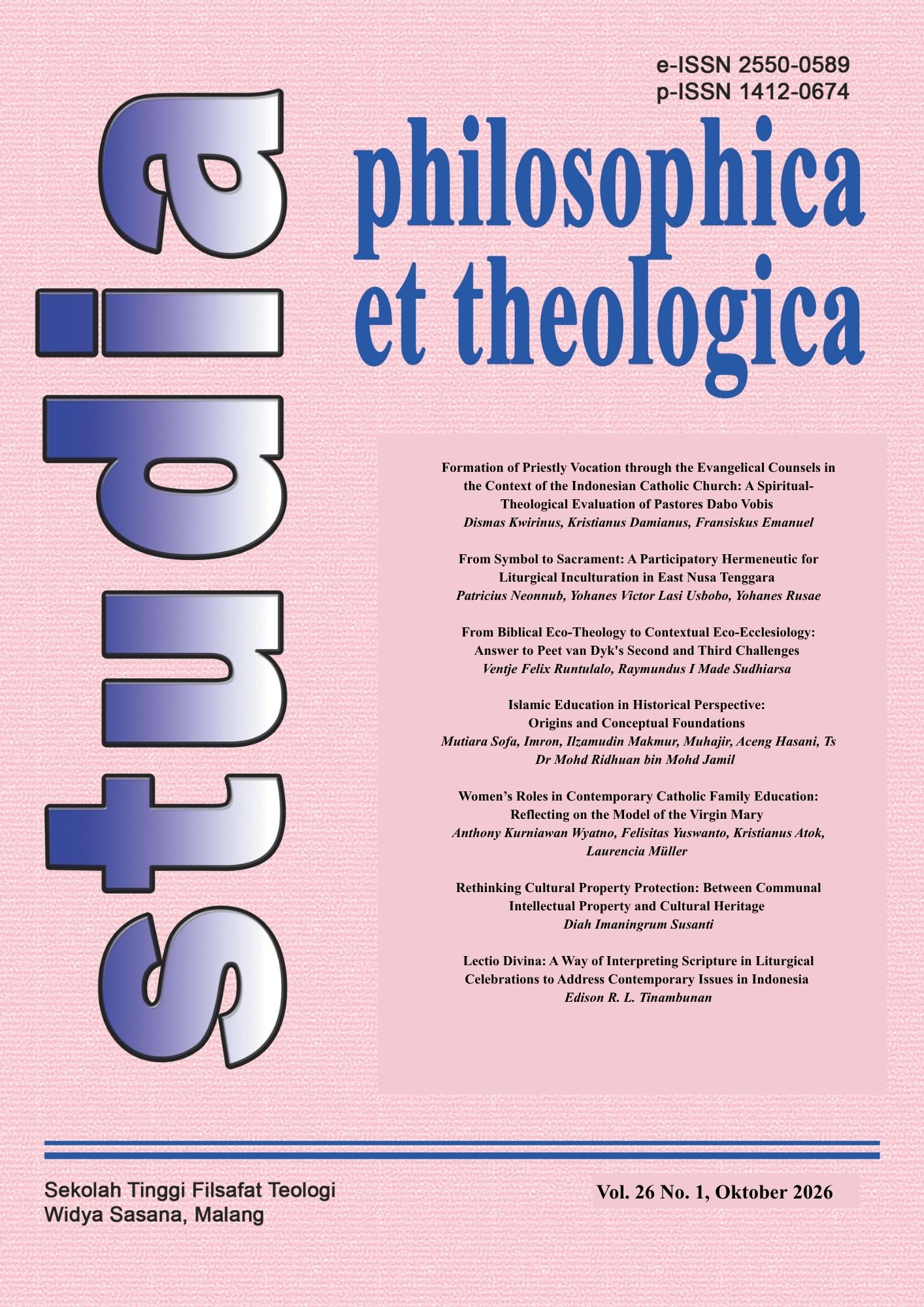
Islamic Education in Historical Perspective: Origins and Conceptual Foundations
DOI:
https://doi.org/10.35312/studia.v26i2.843Keywords:
Islamic education, Islamic epistemology, ‘Ilm, MadrasahAbstract
Abstract
This study aims to examine the epistemological foundations of Islamic education through the concept of ‘ilm (knowledge), which encompasses both religious and worldly dimensions. Historically, classical Islamic thought emphasized that all knowledge is rooted in religion. The typology of Islamic knowledge divides it into two major categories: al-‘ulūm al-‘aqlīyah (rational/argumentative sciences) and al-‘ulūm al-naqlīyah (transmitted sciences). This research employs a library research method with a historical-philosophical analytical approach to both classical and contemporary literature. The findings indicate that there are four main approaches to the acquisition of knowledge: (1) Constructive, through logic and qiyās; (2) Theological, based on kalām; (3) Philosophical, influenced by Neoplatonism and Peripatetic thought; (4) Mystical/theosophical, emphasizing knowledge through presence and intuition. These epistemological principles shaped the institutional model of Islamic education, ranging from mosques and majlis al-‘ilm to madrasahs. At present, madrasahs as Islamic educational institutions face the challenges of modernization and the penetration of Western values. These findings affirm the need for revitalizing Islamic epistemology in order to strengthen the identity of Islamic education and respond to global dynamics.
Keywords: Islamic education; Islamic epistemology; ‘Ilm; Madrasah
Abstrak
Penelitian ini bertujuan mengkaji fondasi epistemologis pendidikan Islam melalui konsep ‘ilm (pengetahuan) yang mencakup dimensi agama dan duniawi. Secara historis, pemikiran Islam klasik lebih menekankan bahwa seluruh pengetahuan berakar pada agama. Tipologi pengetahuan Islam membaginya ke dalam dua kategori besar, yaitu al-‘ulūm al-‘aqlīyah (ilmu rasional/argumentatif) dan al-‘ulūm al-naqlīyah (ilmu yang ditransmisikan). Penelitian ini menggunakan metode studi kepustakaan (library research) dengan pendekatan analisis historis-filosofis terhadap literatur klasik dan kontemporer. Hasil kajian menunjukkan bahwa terdapat empat pendekatan utama dalam pemerolehan pengetahuan: 1) Konstruktif melalui logika dan qiyās, 2) Teologis berbasis kalām, 3) filosofis yang dipengaruhi Neoplatonisme dan peripatetik, 4) Mistis/teosofis yang menekankan pengetahuan melalui kehadiran dan intuisi. Prinsip epistemologis tersebut membentuk model kelembagaan pendidikan Islam, mulai dari masjid, majlis al-‘ilm, hingga madrasah. Saat ini, madrasah sebagai institusi pendidikan Islam menghadapi tantangan modernisasi dan penetrasi nilai-nilai Barat. Temuan ini menegaskan perlunya revitalisasi epistemologi Islam guna memperkuat identitas pendidikan Islam dan menjawab dinamika global.
Kata kunci: Pendidikan Islam; Epistemologi Islam; ‘Ilm; madrasah
References
Addzaky, Khoirul Umam, Uswatun Hasanah, and Zaki Faddad Syarif Zain. “Developing Wasathiyah Epistemology : A Literature-Based Study of Moderate Islamic Knowledge in The Post-Truth Era.” HEUTOGIA:Journal of Islamic Education 4, no. 2 (2024): 199–217. https://doi.org/https://doi.org/10.14421/hjie.42-05.
Agustina, Nelly, Hasan Asari, and Solihah Titin Sumanti. “The Role of Majlis Taklim in Medan City: Institutional Growth, Religious Education, and Social Transformation.” DINIKA : Academic Journal of Islamic Studies 9, no. 1 (2024): 25–48. https://doi.org/10.22515/dinika.v9i1.9854.
Akbar, Rizamul Malik, and Achmad Khudori Soleh. “The Classification of Knowledge Based on Al-Ghazali’s Perspective and Its Relevance to Qur ’ Anic Exegesis.” FITUA: Jurnal Studi Islam 6, no. 2 (2025): 218–28. https://doi.org/https://doi.org/10.47625/fitua.v6i2.1066.
Alkhadafi, Rahmad. “Epistemologi Filsafat Islam.” JMPI; Jurnal Majemen, Pendidikan, Dan Pemikiran Islam 2, no. 1 (2024): 34–31. https://journal.as-salafiyah.id/index.php/jmpi.
Ardiansyah, Yogi, and Said Azren Qadraini. “Qiyas Dalam Ushul Fiqh Definisi, Signifikansi, Dan Aplikasi Kontemporer.” Al-Mashlahah: Jurnal Hukum Islam Dan Pranata Sosial, 2025, 11–22. https://doi.org/10.30868/am.v13i01.8438.
Daun, Hlger, and Reza Arjmand. Handbook of Islamic Education. Springer, 2018. https://doi.org/10.1007/978-3-319-64683-1_3.
Deng, Nuosi. “Study on the Application of Constructivism in Classroom Teaching to Promote Knowledge Construction.” Journal of Education and Educational Research 12, no. 3 (2025): 27–33. https://doi.org/https://doi.org/10.54097/edqwfa34.
Fadly, A, Remiswal, and N Hayati. “Epistemologi Penelitian Kualitatif Dalam Pendidikan Agama Islam Kontemporer.” AJPI: Al-Ilmiya Jurnal Pendidikan Islam 1, no. 2 (2025). https://doi.org/https://doi.org/10.???/al-ilmiya.v.
Fitria, Dinelti, Jamaris, and Sufyarma. “Implementation of Constructivism Learning Theory in Science.” IJHESS: International Journal of Humanities Education and Social Science 1, no. 3 (2021): 228–35. https://doi.org/https://doi.org/10.55227/ijhess.v1i3.71.
Gaffar, Abdul, and Muhammed Anees. “Inclusive Tawhid as an Epistemology of Islamic Education.” FIKROTUNA: Jurnal Pendidikan Dan Manajemen Islam 15, no. 1 (2025): 135–48. https://doi.org/10.32806/jf.v15i1.833.
Habibi, M Dani. “Tauhid Sebagai Dasar Prinsip Pengetahuan Dalam Pandangan Ismail R. Al-Faruqi.” Indonesian Journal of Islamic Theology and Philosophy 6, no. 1 (2024): 73–86. https://doi.org/http://dx.doi.org/10.24042/ijitp.v6i1.22023.
Handoyo, Teguh, and Abdul Khobir. “Masjid Sebagai Pusat Pengembangan Ilmu Keislaman Periode Klasik.” Jurnal Miftahul Ilmi: Jurnal Pendidikan Agama Islam 2, no. 1 (2025): 39–50. https://doi.org/https://doi.org/10.59841/miftahulilmi.v2i1.34.
Hasanah, Umdatul. “Majelis Taklim and the Shifting of Religious Public Role in Urban Areas.” Ilmu Dakwah: Academic Journal for Homiletic Studies 13, no. 34 (2019): 80–90. https://doi.org/10.15575/idajhs.v12i1.4632.
Hayat, Saeed Fayzul, Achmad Abubakar, and Halimah Basri. “Epistemologi Al-Qur’an: Studi Atas Integrasi Wahyu Dan Akal Dalam Tafsir Kontemporer.” Tasamuh: Jurnal Studi Islam 17, no. 2 (2025): 290–307. https://doi.org/https://doi.org/10.47945/tasamuh.v17i2.2312.
Jamal, Anton. “Ijtihad Dan Qiyas Menurut Imam Syafi’i: Hubungan Qiyas Dengan Berbagai Metode Ijtihad Dalam Ushul Fiqh.” MAQASIDI: Jurnal Syariah Dan Hukum 4, no. 1 (2024): 1–10. https://doi.org/10.47498/maqasidi.v4i1.3125.
Khairuni, Nisa, and Anton Widyanto. “Mengatasi Krisis Spiritual Remaja Di Banda Aceh Melalui Revitalisasi Dan Optimalisasi Fungsi Masjid Sebagai Sarana Pendidikan Islam.” DAYAH: Journal of Islamic Education 1, no. 1 (2018): 74–84. https://doi.org/https://doi.org/10.22373/jie.v1i1.2482.
Lannuria, Unita Karinah, Muhammad Yusuf, Muhammad Syamsi Dhuha, and Wismanto. “Masjid Sebagai Pusat Pendidikan Islam Masa Klasik.” JRPP; Jurnal Review Pendidikan Dan Pengajaran 6, no. 3 (2023): 1101–9. https://doi.org/https://doi.org/10.31004/jrpp.v6i3.24827.
Ma’rief, Muammar Iqbal. “Hubungan Pengetahuan Dengan Kehadiran Dan Pengetahuan Dengan Korespondensi Menurut Mehdi Ha ’ Iri Yazdi.” Al-Iqro’: Journal of Islmaic Studies 1, no. 2 (2024): 122–33. https://doi.org/10.54622/aijis.v1i2.325.
Malik, Adam, and Ahmad Barizi. “The Islamic Perspective on Trilogy Epistemology: Bayāni, Burhāni, and ‘Irfāni.” Tajdid 29, no. 1 (2022): 83. https://doi.org/10.36667/tajdid.v29i1.857.
Mulyani, Nina, Ahmad Faisol Ansori, Agus Pahrudin, Sudjawrwo, and Bujang Rahman. “The Philosophy of Knowledge in Islam and Its Role in Shaping Educational Management Startegies.” Al-Idarah: Jurnal Kependidikan Islam 15, no. 01 (2025): 1–10. https://ejournal.radenintan.ac.id/index.php/idaroh/article/view/26101?utm_source.
Nasir, Sahilun A. “The Epistemology of Kalam of Abu Mansur Al-Maturidi.” Al-Jami’ah: Journal of Islamic Studies 43, no. 2 (2005): 349. https://doi.org/10.14421/ajis.2005.432.349-365.
Putra, Bilal Indra, Husni, and Sri Wahyuni. “Epistemological Differences in Islam : Traditional , Rational , and Sufistic Approaches.” JRSSEM: Journal Research of Social Science, Economics, and Management 4, no. 12 (2025): 2393–2401. https://doi.org/https://doi.org/10.59141/jrssem.v4i12.943.
Sahin, Abdullah. New Directions in Islamic Education Pedagogy & Identity Formation. First publ. England United Kingdom: Kube Publishing Ltd Markfield, 2013. www.kubepublishing.com.
Subhan. “Epistemology of Knowledge in the Perspective of the Quran.” Journal of Social Research 5, no. 1 (2025): 34–45. http://ijsr.internationaljournallabs.com/index.php/ijsr%0AEpistemology
Suhendi, Andang, Purwarno Purwarno, and Sri Chairani. “Constructivism-Based Teaching and Learning in Indonesian Education.” AICIL: Annual International Conference on Languange and Literature 2021 (2021): 76–89. https://doi.org/https://doi.org/10.18502/kss.v5i4.8668.
Suradi, A. “Islamic Education in Facing the Phenomena of Globalization: Epistemology Perspective of Islamic Education Philosophy.” Al-Idarah: Jurnal Kependidikan Islam VII, no. II (2017): 1–22. https://doi.org/https://doi.org/10.24042/alidarah.v7i2.2260.
Syafaq, Hammis, Masdar Hilmy, Nur Lailatul Musyafaah, and Mohammed Ramadhan Abraheem Alshaykh Ali. “Reconstructing Islamic Epistemology: Bridging Metaphysics, Reason, and Revelation.” TEOSOFI: Jurnal Tasawuf Dan Pemikiran Islam 14, no. 2 (2024): 240–69. https://doi.org/10.15642/teosofi.2024.14.2.240-269.
Tahqiq, Nanang. “Epistemology Islam.” Refleksi: Jurnal Kajian Agama Dan Filsafat V, no. 1 (2025): 77–92. https://journal.uinjkt.ac.id/refleksi/article/view/40461/pdf.
Umam, Nasrul, and Faizal Imam Muarif. “Masjid-Based Pesantren: Revitalizing the Role of Mosques as Centers of Islamic Education Rooted in Local Wisdom in Indonesia.” Wah Academia Journal of Social Science 4, no. 1 (2025): 2958–8723. https://doi.org/https://doi.org/10.63954/WAJSS.4.1.58.2025.
Downloads
Published
Issue
Section
License
Copyright (c) 2026 Mutiara Sofa

This work is licensed under a Creative Commons Attribution-ShareAlike 4.0 International License.


